
What Is a Pump Tank (Dosing Tank) in a Septic System?
- Home
- Septic Glossary
- Pump tank (dosing tank)


832-789-5357
Quick answer
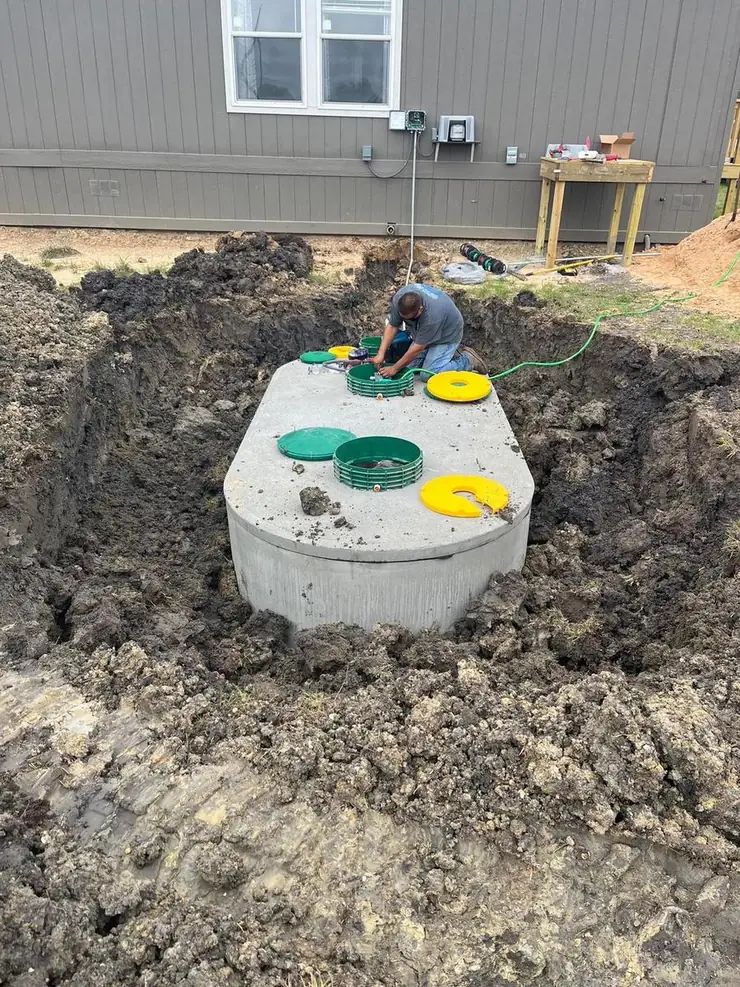
A pump tank, also called a dosing tank, is the chamber where treated water collects before a pump sends it out to the spray heads, drip lines or drain field. It meters the water out in controlled doses. A rising water level in this tank is the most common trigger for aerobic septic alarms.
Many homeowners first meet the pump tank when an alarm goes off. That is no accident: this chamber holds the pump, the floats and the level controls that decide when your system sends water out.
What does a pump tank do?
Treated water from the main tank or treatment unit flows into the pump tank by gravity. It waits there until a float or timer tells the pump to run. The pump then pushes a measured dose to the dispersal area. Sending it in doses, instead of letting it trickle out all day, spreads it evenly and gives the soil time to rest between applications.
That is why it is also called a dosing tank. The name "pump tank" and "dosing tank" describe the same chamber.
What is inside a pump tank?
- A submersible pump set near the bottom.
- Several float switches at different heights to start the pump, stop it and signal a high level.
- Often an effluent filter on the pump's intake or inlet.
- A line running up to the spray heads, drip field or drain field.
- Wiring that runs back to the control panel.
Layouts vary by manufacturer and by the type of dispersal. Some systems have a separate tank, while on others the pump chamber is a compartment of a larger unit.
What goes wrong with a pump tank?
- Stuck or tangled float. The pump never starts, or never stops.
- Failed pump. Water rises with nowhere to go, and the alarm sounds.
- Clogged filter or line. The pump runs but the water cannot move.
- Too much incoming water. Heavy rain, a leaking fixture or a long run of laundry can fill the tank faster than the pump can empty it.
When the water level climbs to the top float, the alarm light and buzzer come on. Read our guide to the red light on an aerobic septic alarm for what to do first. In short, cut back on water use and call for service.
How is a pump tank maintained?
A technician inspects the pump, floats, filter and wiring on routine visits, checks that the pump cycles correctly and cleans the tank when it needs it. These checks are part of a maintenance contract. Texas generally requires one on aerobic systems, at least for the first two years.
Do not open the tank or work on the pump or wiring yourself. The gases in a tank are dangerous and the electrical parts are live. If lids are buried, risers and accessible lids make service quicker and safer.
If your alarm is sounding or the pump sounds wrong, call 832-789-5357 or see our aerobic alarm repair service. Se habla español.
Related septic terms
Quick questions and answers
- Is a pump tank the same as a septic tank?
No. A septic tank settles and stores solids. A pump tank holds already-treated water and uses a pump to send it to the dispersal area. Some systems have both as separate chambers.
- Why does my pump tank alarm keep coming on?
Common causes include a failed pump, a stuck float, a clogged filter or too much water entering the system. A technician can find which one by testing the pump and floats.
- Do all septic systems have a pump tank?
No. Gravity-fed conventional systems usually do not. Spray systems, drip systems and many aerobic systems need one to push water uphill or spread it out in measured doses.
Related guides and services
← Back to the full septic glossary
Ready to get started?
Call 832-789-5357, request a quote, or book online. Se habla español.



