


832-789-5357
Quick answer
A failing drain field shows up as slow drains throughout the house, gurgling, sewage odor near the yard, soggy ground or standing water over the field, and sewage backing up. If you see several of these, cut back water use, keep vehicles off the area, and call a septic professional to find the cause before anything gets worse.
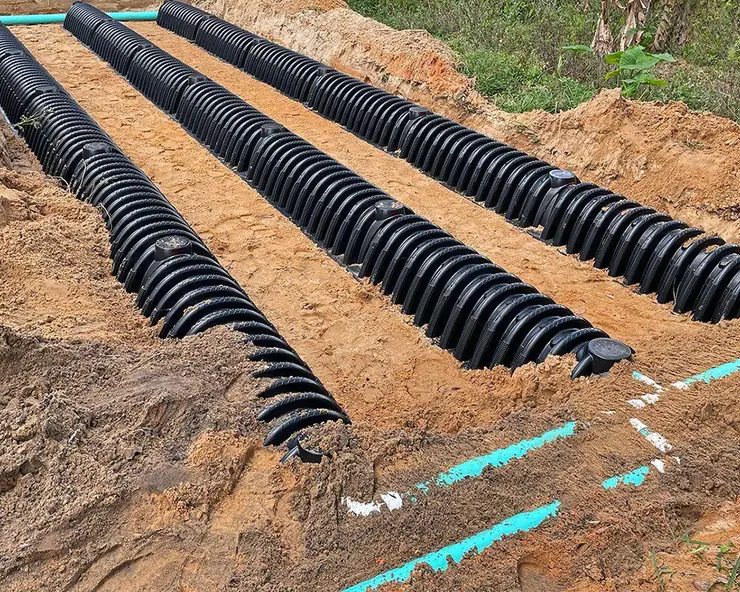
The drain field, also called the leach field or dispersal area, is where septic wastewater finally goes back into the ground. When it stops absorbing water, the water has nowhere to go. It can rise to the surface or back up into the house. The earlier you catch it, the more options you have.
What are the signs of a failing drain field?
- Slow drains everywhere. One slow sink is usually a local clog. Slow toilets, tubs and sinks all at once point to the system.
- Gurgling pipes. Air and water are struggling to move through the system.
- Sewage odor outdoors. A smell near the tank or the field suggests wastewater is near the surface.
- Soggy or spongy ground. Wet soil over the field when the weather has been dry is a warning sign.
- Standing water or surfacing effluent. Wastewater pooling on the ground is a health hazard and a clear sign of trouble.
- A strip of unusually lush, dark grass over the field, especially next to dormant lawn.
- Backups. Wastewater in the lowest drain, shower or toilet in the house, which usually means the system is full.
- An alarm that keeps coming back on an aerobic system, which may mean the dispersal side cannot take the water. See the aerobic alarm red light.
What is normal and what is not?
Not every wet patch means failure. Around Greater Houston, heavy rain and a high water table can make any yard soggy for a few days, including a healthy field. The difference is how long it lasts and whether you also see odor, backups or effluent. Compare these:
- Probably normal: damp ground for a day or two after heavy rain that dries out, with no odor and normal drains.
- Not normal: wet ground that stays wet in dry weather, any smell of sewage, wastewater on the surface, or backups in the house.
- On a spray system: wetness right at a spray head may be a clogged or misaligned head rather than a failed field. A technician can tell the difference.
- After flooding: a field under water cannot absorb anything. See septic system recovery after flooding before assuming it has failed.
What should I do first?
- Reduce water use right away. Space out laundry, skip long showers and stop running water that is not needed.
- Keep people, children and pets away from any wet or smelly area.
- Check the control panel and alarm if you have an aerobic system.
- Look at when the tank was last pumped. A full tank can mimic a failing field, and pumping may be part of the answer.
- Call a septic professional. A diagnosis should come before any spending.
What should I avoid doing?
- Do not keep pumping the tank over and over as a fix. It only buys a little time if the field is not absorbing.
- Do not use additives or chemical drain-field treatments. They rarely help and can harm the bacteria in the tank.
- Do not drive, park or build on the field. Compaction makes absorption worse.
- Do not plant trees nearby or dig in the area without checking where the lines run.
- Do not redirect gutters, sump pumps or a pool drain toward the field.
- Do not open the tank and climb in. Septic tanks contain dangerous gases.
Can a drain field be repaired, or does it need replacement?
It depends on why it failed. Common causes include a tank that went too long without pumping, solids carried over into the lines, a damaged pipe or distribution box, roots, compaction, and soil that simply cannot take the daily flow.
A repair is realistic when the problem is localized, such as a broken line, a blocked distribution point, a failed pump or a clogged spray head. We handle those through drain field repair. A camera inspection can show what is happening inside the lines before anything is dug up.
Replacement is the answer when the soil in the field is saturated or clogged throughout, or when the original design never suited the lot. On Greater Houston clay, replacement often means changing the approach, for example moving to an aerobic system with drip or spray dispersal. See drain field replacement and drip vs spray dispersal. A replacement needs a design and generally a permit, covered in our septic permit guide.
How do I get a straight answer?
Call Brown Aerobic at 832-789-5357. We will look at the tank, the pumps, the lines and the field, tell you what is failing and why, and give you repair and replacement options in writing. We serve Harris, Montgomery, Waller, Fort Bend, Austin, Grimes and Brazoria counties, and estimates are free.
Quick questions and answers
- What is the first sign of a failing drain field?
Often it is slow drains throughout the house, gurgling, or a damp, smelly patch over the field when the weather has been dry. Any wastewater on the surface or backing up indoors is a sign to call right away.
- Can a failed drain field fix itself?
Rarely. Resting the field and cutting water use can help if the cause is overload, but clogged or saturated soil does not usually recover on its own. A technician can tell you whether it is worth trying.
- Is a wet yard after heavy rain a failed drain field?
Not necessarily. Heavy rain and a high water table can saturate any yard for a day or two. If the ground stays wet in dry weather, smells like sewage or you have backups, get it checked.
- Will pumping the tank fix a failing drain field?
Sometimes it relieves a full tank and buys time, but it does not repair a field that has stopped absorbing. If symptoms come back soon after pumping, the field or dispersal system needs to be diagnosed.
Related reading and services
More guides
Ready to get started?
Call 832-789-5357, request a quote, or book online. Se habla español.



