

832-789-5357
Texas is home to some of the most varied and challenging geology in the United States. While properties in Montgomery County might sit on well-draining sandy loam, homeowners closer to the Gulf Coast face a completely different reality. If you live in the eastern Houston suburbs, Pearland, or coastal regions of Harris and Fort Bend Counties, your home likely sits on Houston Black Clay or Beaumont Clay.
Understanding this heavy clay soil is critical because the dirt under your lawn is not just holding your septic system in place — it is the active biological engine that treats and disperses your wastewater. When that engine is built of dense clay, the rules of septic maintenance completely change.
The Problem with Heavy Clay Soil
A conventional septic system relies on a drain field (or leach field) to process wastewater. After solids settle in the septic tank, the liquid effluent flows out into a network of perforated pipes buried in the soil. The soil's job is to absorb this liquid and naturally filter out bacteria and pathogens before the water reaches the groundwater table.
The speed at which soil can absorb this water is known as its Long-Term Acceptance Rate (LTAR). The Texas Commission on Environmental Quality (TCEQ) classifies soils into five categories based on this permeability.
As the table shows, Class IV heavy clay soil absorbs water at roughly one-quarter the speed of ideal sandy loam. In fact, Houston Black Clay often has a percolation rate of less than 0.1 inches per hour. Because the soil absorbs water so slowly, the effluent stays trapped near the surface. This leads to rapid drain field saturation. When the soil cannot process the daily volume of wastewater your family produces, the water has nowhere to go but backward — resulting in slow drains, gurgling pipes, and sewage pooling in your yard.
The Drought-to-Deluge Cycle
Houston's climate makes the clay soil problem even worse. Texas weather frequently swings between intense droughts and torrential rainstorms. This cycle places immense physical stress on underground septic infrastructure.
During a hot Texas summer, expansive clay soil dries out, shrinks, and forms deep cracks. These cracks can physically shift the ground, putting pressure on septic tanks and PVC distribution lines until they snap. When heavy rains finally return, the water rushes down these drought cracks, bypassing the natural soil filtration layers and carrying heavy silt directly into the drain field, which accelerates clogging.
Conversely, during a sudden deluge, the dense clay becomes instantly saturated. The soil's pore spaces fill with rainwater, leaving zero room for your septic system's effluent to escape. This causes immediate hydraulic overload and system backups.
Solutions for Clay Soil Properties
If your property sits on heavy clay, a standard gravity-fed conventional septic system is likely to fail prematurely. In areas with high clay content, failure rates for conventional systems can be shockingly high. Fortunately, modern septic engineering provides highly effective solutions.
Aerobic Treatment Units (ATUs)
The most common and effective solution for Houston's clay soil is an Aerobic Treatment Unit. Unlike a conventional tank that relies on slow anaerobic bacteria, an ATU uses an air compressor to inject oxygen into the treatment chamber. This oxygen feeds aggressive aerobic bacteria that break down waste much faster and more thoroughly.
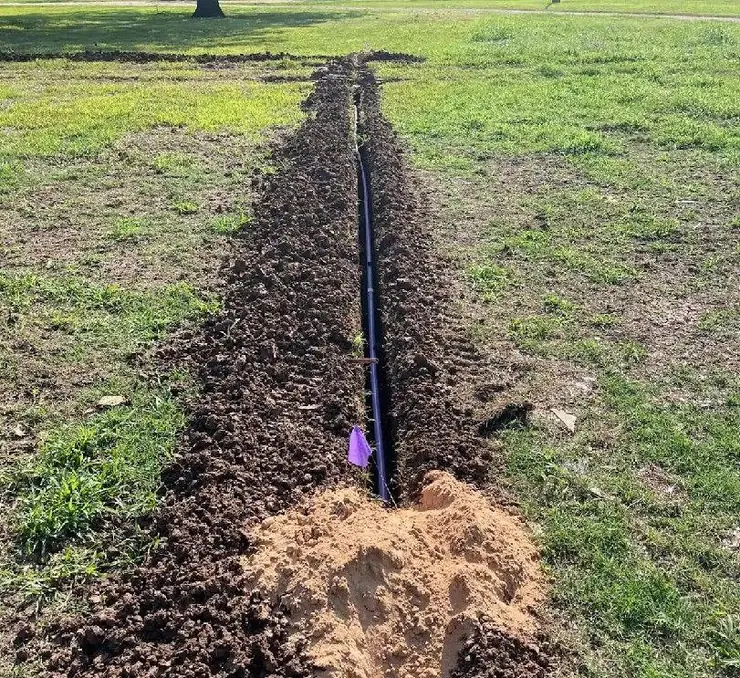
Because the effluent produced by an ATU is highly treated and disinfected (usually with chlorine), it does not need to be filtered through deep, permeable soil. Instead, the clean water is safely dispersed across the surface of the lawn using spray heads, or just below the surface using drip irrigation lines. This completely bypasses the limitations of dense clay soil.
Larger Drain Fields
If a conventional system is permitted, it must be engineered specifically for the soil type. Because clay absorbs water so slowly, the drain field must be significantly larger to spread the daily wastewater load over a wider area. In many cases, a clay soil drain field requires roughly double the linear pipe length of a system built in sandy soil.
How to Protect Your System
If you already own a home with a septic system in a clay-heavy area, proactive maintenance is your best defense against premature failure.
First, you must pump your tank more frequently. While a system in sandy loam might go three to five years between pump-outs, a system in heavy clay should be pumped every two to three years. Keeping solid waste strictly inside the tank prevents the drain field's soil pores from becoming permanently sealed by organic sludge.
Second, practice strict water conservation. Because clay drains slowly, doing five loads of laundry on a Saturday can easily overwhelm the system. Spread high-water activities out over the week, and avoid using garbage disposals, which add unnecessary solids and water to the tank.
Living on Houston clay does not mean you are doomed to septic failure; it simply means your system requires the right design and an experienced partner. Contact Brown Aerobic Service Company today. Our licensed professionals understand the unique soil challenges across the Gulf Coast and can provide the expert pumping, repair, and aerobic installation services your property needs.
Related services
More guides
Ready to get started?
Call 832-789-5357, request a quote, or book online. Se habla español.